



Living Things Encyclopedia No.008
Penguins
Birds · Order SphenisciformesSeabirds that swim well and do not fly
Penguins are flightless seabirds that live mainly in the Southern Hemisphere. They use their wings like flippers for swimming and move quickly through the water. The number of species is said to be about 17 to 19, depending on how they are divided.
Key facts
| Classification | Kingdom Animalia, phylum Chordata, class Aves (birds), order Sphenisciformes, family Spheniscidae. They are usually divided into 6 genera (groups of close relatives). |
|---|---|
| Number of species | It differs depending on how they are counted: about 17 to 19 (accounts differ). Many sources say 18. |
| Size | The largest, the emperor penguin, is about 1 m long and weighs about 20 to 45 kg (this differs by source, individual and season). The smallest, the little penguin (fairy penguin), is about 30 to 40 cm long and weighs about 1 kg (this differs by source). |
| Habitat and range | Most live in the Southern Hemisphere. They live not only around Antarctica but also on coasts and islands of South America, southern Africa, Australia, New Zealand and other places. They also live in the Galapagos Islands, near the equator. |
| Food | Fish, squid, krill (small shrimp-like animals) and more. Tastes differ by species. |
| Features | They cannot fly. Their wings are shaped like flat flippers, and their bodies are streamlined so they move easily in water. |
| Time they lived | Among the oldest penguin-group fossils are ones from about 60 million years ago (the Paleocene). They have been found in New Zealand. |
| Conservation status | It differs by species, and some species are decreasing in number. For details, check the latest assessment by the IUCN (International Union for Conservation of Nature). |
What kind of animal is it?
Penguins are birds. But they cannot fly. Instead, they are very good at swimming in the sea.
They live mainly in the southern half of the Earth (the Southern Hemisphere). People often think "penguin = world of ice," but some species actually live in warm places. For example, the Galapagos penguin lives near the equator, in the Galapagos Islands.
The number of species differs a little depending on how researchers divide them. It is thought to be about 17 to 19, and sources that say 18 are often used.
Body and features
A penguin's wings have changed into stiff, flat "flippers." In the water, it moves these flippers and swims as if it were flying.
Its body is round and streamlined (a shape that has little resistance from water or air). That is why it can glide through the water easily.
On land, it stands upright and waddles. Some species also slide on their bellies over ice.
A dark back and a white belly are shared by many species. This is thought to make them hard to notice when seen from above or below in the sea.
Size comparison
The largest penguin is the emperor penguin. It is about 1 m long and weighs about 20 to 45 kg. The numbers vary depending on how it is measured, and on the individual and the season.
The smallest is the little penguin (fairy penguin). It is about 30 to 40 cm long and weighs about 1 kg. The numbers differ a little by source.
How they live
Penguins catch and eat fish, squid, krill and other food in the sea. Food and the depth they dive to differ by species.
They lay eggs and raise their chicks on land or on ice. The chicks are covered with fluffy down (soft feathers). This down looks different from an adult's feathers.
The emperor penguin and the Adelie penguin are well known as species that raise their young on the coast of the Antarctic continent. Other species raise their young on southern islands or along continental coasts.
Many species live in large groups of parents and chicks, forming lively colonies.
Penguins of long ago
Fossils show that the penguin group has existed for a very long time. In New Zealand, fossils from about 60 million years ago (the Paleocene) have been found. They belong to a group called Waimanu.
Waimanu is thought to have been a little smaller than today's penguins, or about the same size. However, estimates of size differ by source.
Some ancient penguins were also much bigger than today's. For example, Anthropornis, which lived about 45 to 33 million years ago, is known as one of the large ancient penguins.
Penguins and people
Penguins are popular animals at aquariums and zoos. In Japan, too, you can see them at many facilities.
On the other hand, some wild penguin species are decreasing in number. The reasons are thought to be varied, such as changes in sea temperature, fewer fish to eat and human activities.
When you go to see wild penguins, it is important not to get too close to their nests or to parents and chicks. Research and efforts to protect penguins continue around the world.
About this illustration
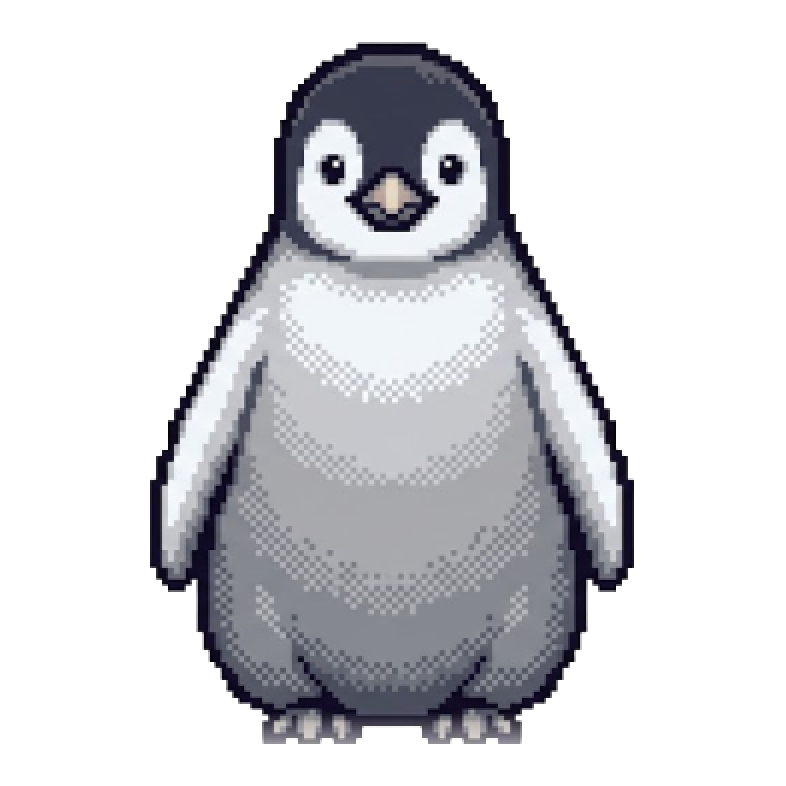
This is a pixel-art picture (a picture made of small square dots) of a fluffy gray penguin chick. You can use it as a cute animal icon. The color of a real penguin chick's down differs by species, and many are grayish. The fine colors, expression and pose in the picture are the artist's own, and differ from real penguins.
Fun facts
- Most penguin species live in the Southern Hemisphere. Wild penguins are not usually found in the Northern Hemisphere.
- The Galapagos penguin lives near the equator and is known as the species that lives farthest north.
- One of the oldest penguin fossils has been found in New Zealand. It dates from about 60 million years ago.
Quick quiz
Q. Which is a correct statement about penguins?
Penguins are birds that cannot fly, and their wings are shaped like flippers for swimming. They live mainly in the Southern Hemisphere, and some species live near the equator.
References
- 国立極地研究所 南極・北極科学館の資料 (National Institute of Polar Research, Antarctic and Arctic Science Museum materials): supports the emperor penguin's length and weight
- IOC World Bird List (the bird classification list of the International Ornithological Congress): supports the classification of the penguin family and the number of species
- Animal Diversity Web (University of Michigan animal database), "Sphenisciformes" (the penguin order) entry
- Slack et al. 2006, "Early penguin fossils, plus mitochondrial genomes, calibrate avian evolution" (Molecular Biology and Evolution): supports the old penguin fossils such as Waimanu
- IUCN(国際自然保護連合)レッドリスト (IUCN Red List): supports the conservation status of each penguin species
Accounts may differ between sources and regions, and facts or figures can change with new research or rules. This page was translated from the Japanese original.
Download the pixel art
- Free
- No registration
- Commercial use OK
- Edits OK
- Credit optional
- No usage report needed
Please read the terms of use before using it.