



Periodic Table Encyclopedia No.029
Copper
Transition metalMetalGroup 11, Period 4
Atomic number 29, symbol Cu. Copper is a reddish-brown metal that carries electricity very well. People have used it since ancient times, and it is used in electric wires and coins.
Key facts
| Atomic number / Symbol | 29 / Cu |
|---|---|
| Type | Metal (a transition metal, one of the metals found in the middle part of the periodic table). It is in the same column as gold and silver. |
| Place in the periodic table | Group 11, Period 4 |
| State at room temperature | Solid (reddish-brown and shiny) |
| Atomic weight | About 63.546 (IUPAC standard atomic weight, as of the 2020s) |
| Melting point (the temperature at which it melts) | About 1085 °C (sources differ a little, from about 1083 to 1085 °C) |
| Discovery | Known since ancient times, and no one knows who discovered it. People are said to have started using it several thousand years ago, or even nearly 10,000 years ago. Accounts differ. |
| Origin of the name | The symbol Cu comes from the Latin word cuprum. It is said to come from a phrase meaning "metal of the island of Cyprus." However, accounts differ on whether the island's name or the metal's name came first. |
What kind of element is it?
Copper is a metal with the symbol Cu and atomic number 29. It is reddish brown, and it shines brightly when polished.
Most metals are silver or gray. A metal with a clear color like copper is rare, and gold is another one. In the periodic table, copper is in Group 11 (a vertical column), together with gold and silver.
Copper is also easy to stretch and bend, and it carries heat and electricity very well. Among metals, it is said to carry electricity second best, after silver.
A history of discovery
Copper is one of the metals that people began to use very early. It can sometimes be found in nature as a lump of pure metal. People are thought to have hammered such lumps into tools and decorations. Later, people also found ways to take copper out of ore (rock that contains metal).
No one knows who first found copper, so the discoverer is "unknown."
Bronze is made by mixing tin into copper. It is hard and strong, so it was used for tools, mirrors and bells in the past. This is why one period of history is called the Bronze Age.
In Japan, the copper coin Wadokaichin is generally thought to have started being made in 708. A copper coin called Fuhonsen, from before that time, has also been found.
The secret of the name
The symbol Cu comes from the Latin word cuprum. It is said to have changed from a phrase meaning "metal of the island of Cyprus." Cyprus was famous as a place where copper was produced in ancient Roman times.
However, researchers disagree about whether the island's name became the metal's name, or the other way around. Accounts differ.
The English word "copper" also comes from the same word. In old Japan, copper was also called "akagane," which means "red metal," because of its color.
Everyday uses
The most familiar use is in electric wires. Copper is used a lot in the cords in your home and in the wiring inside machines. Because it carries heat well, it is also used for pots and kettles.
Alloys (mixtures of metals) made with copper are important too. Brass is made by mixing copper and zinc. Its color is close to gold, and it is made into musical instruments and parts. Bronze is copper mixed with tin.
A Japanese 10-yen coin is about 95% copper, and the rest is zinc and tin. Its brownish color is the color of copper.
Secrets of its properties
As time passes, the surface of copper changes because of air and water. It starts out reddish brown, slowly turns dark brown, and after many years it can get a blue-green rust. This rust is called verdigris (rokusho in Japanese).
This is why the roofs of old temples and big bronze statues are blue-green. Once verdigris covers the surface, the inside is less likely to change.
Copper is also one of the elements that living things need, in very small amounts. But taking in too much is not good. For details, please check information from public agencies.
About this illustration
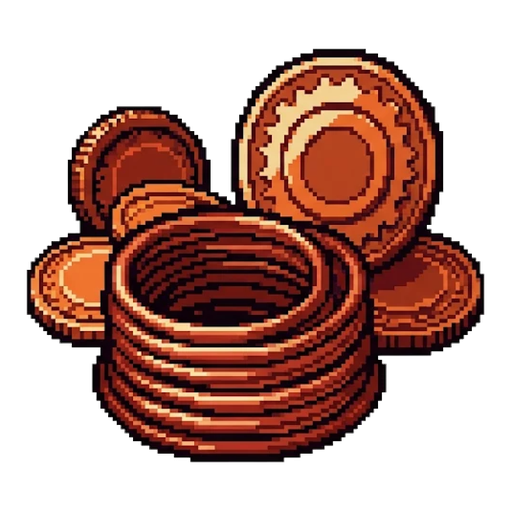
The picture shows a coil of reddish-brown copper wire wound in a circle, and coins the color of copper. The shine of the metal and the warm reddish-brown color are typical of copper. The background color, small decorations and the way the light sparkles are part of the artist's drawing and differ from the real thing.
Fun facts
- Among metals, copper is said to carry electricity second best, after silver.
- Gold is another metal with a clear color, like copper.
- The blue-green rust called verdigris forms when copper changes over many years.
Quick quiz
Q. Which alloy is made by mixing tin into copper, and was used for old tools and bells?
Copper mixed with tin is bronze. Brass is copper with zinc, and verdigris is the blue-green rust that forms on the surface of copper.
References
- IUPAC / CIAAW "Standard Atomic Weights" (supports copper's atomic weight, about 63.546)
- Japan Mint's explanation of coins (supports the makeup of the 10-yen coin: copper 95%, zinc 3–4%, tin 1–2%)
- National Astronomical Observatory of Japan, ed., "Rika Nenpyo" (Chronological Scientific Tables) (supports values such as element properties and melting point)
- van der Krogt, "Elementymology & Elements Multidict" (supports the origin of the name Cu)
- "Shoku Nihongi" (supports the record of copper coins in the first year of the Wado era)
Accounts may differ between sources and regions, and facts or figures can change with new research or rules. This page was translated from the Japanese original.
Download the pixel art
- Free
- No registration
- Commercial use OK
- Edits OK
- Credit optional
- No usage report needed
Please read the terms of use before using it.