



Periodic Table Encyclopedia No.025
Manganese
Transition metalMetalGroup 7, Period 4
Atomic number 25, symbol Mn. It is a hard metal that looks like iron. Huge amounts are used to make iron stronger. A black mineral that contains it is also used in dry-cell batteries.
Key facts
| Atomic number / Symbol | 25 / Mn |
|---|---|
| Group | Transition metal (a kind of metal) |
| Place in the periodic table | Group 7, Period 4 |
| State at room temperature | Solid (a silvery-gray metal. Hard but brittle) |
| Atomic weight | About 54.938 (the IUPAC standard atomic weight, as of the 2020s) |
| Melting point (the temperature where it melts) | About 1246 °C (sources differ by 1 to a few degrees) |
| Boiling point (the temperature where it turns into gas) | About 2061 °C (sources differ a little) |
| Discovery | Around 1774. Scheele and Bergman showed that pyrolusite (a blackish mineral) contains a new metal. In the same year, Gahn heated it with carbon and took out an impure metal. Gahn is usually named as the discoverer, but some sources say Kaim made the metal first, in 1771. Accounts differ |
| Origin of the name | Said to come from the Latin "magnesia nigra" (black magnesia) and "magnes" (magnet), among other words. Accounts differ about the exact path |
What kind of element is it?
Manganese is a metal with the symbol Mn and atomic number 25. It looks silvery-gray, very much like iron. It is hard, but brittle, which means it can break under strong force.
In the periodic table, it sits just to the left of iron. In the Earth's crust (the layer of rock that forms the surface of the Earth), it is fairly common for a metal. It is said to be the fifth most common metal there.
You rarely see pure manganese metal in daily life. But it works hard inside steel and batteries.
The history of its discovery
People have known the blackish mineral (pyrolusite) since ancient times. It is said to have been used to adjust the color of glass.
In 1774, the Swedish chemists Scheele and Bergman showed that this black mineral holds an oxide (a substance joined with oxygen) of a metal nobody knew yet. In the same year, Gahn heated the mineral together with carbon and took out impure manganese metal.
For this reason, Gahn is usually named as the discoverer. But some sources say Kaim made the metal first, in 1771. Sources explain who deserves how much credit in different ways, so accounts differ.
The secret of its name
The name is said to come from a word linked to the Magnesia region of Greece. The black mineral was called "black magnesia" (magnesia nigra). Another view says it comes from the Latin word for "magnet."
Long ago, the name was easy to confuse with today's magnesium. Different metals were sometimes called by similar names. Sources explain how the names changed in different ways.
How we use it
The biggest use of manganese is in steel (a material made from iron). Mixing in manganese makes iron stronger and harder to wear down. Most of the manganese made is said to go into steelmaking.
Another familiar use is the dry-cell battery. Inside the battery is manganese dioxide (a blackish powder where manganese is joined with oxygen). It is used as the material for the positive side of manganese and alkaline dry cells.
The name "manganese" in manganese dry cells comes from this material.
Secrets of its properties
When manganese joins with other elements, it can link up in many different ways. Because of this, its compounds (substances made by combining it with other elements) come in many colors. For example, a substance called potassium permanganate turns a deep purple when it is dissolved in water.
Manganese is also one of the elements that people, animals and plants need in very small amounts. But breathing in a lot of it over a long time is said to be bad. For how to handle it, check the information from official agencies.
On Earth and in space
Manganese is found underground mainly in minerals such as pyrolusite. It is dug out of mines and made into materials such as steel.
On the sea floor, potato-shaped lumps that contain manganese (manganese nodules) have been found. But how to use them is still being discussed, because we must also think about the effects on the environment.
About this illustration
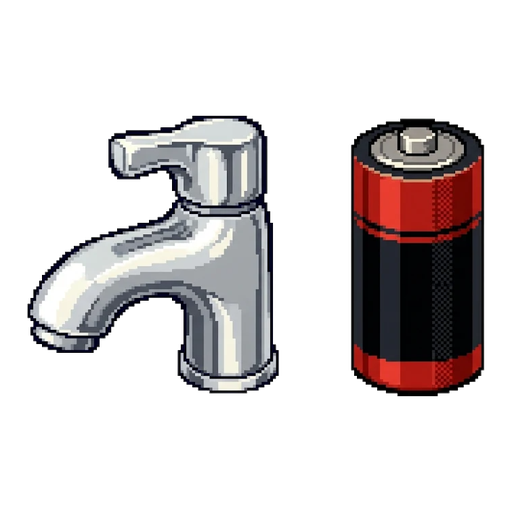
This is an illustration of a black dry-cell battery. The picture is inspired by the fact that the blackish powder inside a dry cell is manganese dioxide, and it is drawn as a black cylinder. But it shows a battery, not the metal manganese itself. Real manganese metal is silvery-gray. The battery's color, shape and decorations are the artist's own style and differ from the real thing.
Fun facts
- Manganese dioxide is used as the positive-side material in manganese and alkaline dry cells.
- Potassium permanganate is well known for turning a deep purple when dissolved in water.
- Lumps called "manganese nodules" that contain manganese have been found on the sea floor.
Quick quiz
Q. Which blackish substance that contains manganese is used inside dry-cell batteries?
Manganese dioxide is used as the positive-side material in manganese and alkaline dry cells. Potassium permanganate is a different substance that turns purple in water.
References
- Encyclopaedia Britannica, "Manganese" (supports the discovery story and the use in steel)
- Royal Society of Chemistry, "Periodic Table: Manganese" (supports the melting point 1246 °C and boiling point 2061 °C, uses, amount in the crust, discovery and the origin of the name)
- CIAAW (Commission on Isotopic Abundances and Atomic Weights), "Abridged Standard Atomic Weights" (supports the standard atomic weight of about 54.938)
- NIST, "Atomic Weights and Isotopic Compositions for Manganese" (supports the atomic weight and isotope data)
- Elementymology & Elements Multidict (supports the explanation of the origin of the name manganese)
Accounts may differ between sources and regions, and facts or figures can change with new research or rules. This page was translated from the Japanese original.
Download the pixel art
- Free
- No registration
- Commercial use OK
- Edits OK
- Credit optional
- No usage report needed
Please read the terms of use before using it.