



Periodic Table Encyclopedia No.009
Fluorine
HalogenNonmetalGroup 17, Period 2
Atomic number 9, symbol F. It is a pale yellow gas that joins with other substances very strongly. Its compounds, called fluorides, are used in toothpaste and similar products to protect teeth.
Key facts
| Atomic number / symbol | 9 / F |
|---|---|
| Classification | Halogen (a member of Group 17). A nonmetal. |
| Place in the periodic table | Group 17, Period 2 |
| State at room temperature | Gas (made of F₂ molecules; pale yellow with a strong smell) |
| Atomic weight | About 18.998 (IUPAC standard atomic weight, as of the 2020s) |
| Melting point / boiling point | Melting point is about minus 220°C. Boiling point is about minus 188°C. |
| Discovery (first isolated as a pure element) | 1886, by Moissan of France. He received the Nobel Prize in Chemistry in 1906. |
| Origin of the name | From the mineral fluorite. It comes from a Latin word meaning "to flow." Sources differ on who named it, so accounts differ. |
What kind of element is it?
Fluorine is the element with symbol F and atomic number 9. In the periodic table, it is a halogen in Group 17 (a group that includes chlorine and iodine).
The pure element (a substance made only of fluorine) is a pale yellow gas. Its power to join with other elements is among the strongest of all elements. For this reason, fluorine is almost never found as a gas in nature. It usually exists joined with other elements, as compounds.
Fluorine gas is very poisonous, and ordinary people do not handle it. It is used only in places with special equipment.
The history of its discovery
Fluorite is a mineral that contains fluorine. Long ago, it was mixed in when melting metals, to help them melt more easily. So the name is said to come from a Latin word meaning "to flow."
But fluorine joins with other things so strongly that it was very hard to separate. Many chemists tried for more than 70 years.
In 1886, Moissan of France finally separated fluorine gas using electricity to split a substance apart (electrolysis). For this work, he received the Nobel Prize in Chemistry in 1906.
As for who named the element, sources give different accounts, so accounts differ.
Everyday uses
The most familiar use is toothpaste. Many toothpastes contain fluorine compounds (fluorides). Fluorides are said to help prevent cavities by making the surface of teeth stronger against acid (the substance made by cavity-causing germs that melts teeth).
In Japan, there is a local government document saying that about 90% of toothpastes sold in stores contain fluorides.
Resins that contain fluorine (fluorine resins) are also used for the non-stick coating on frying pans. They resist heat and chemicals, and they are very slippery.
There are guidelines on how much toothpaste to use for each age. For details, please check with a dentist or public organizations.
Secrets of its nature
Fluorine is said to have the greatest power of all elements to pull in electrons (tiny particles inside atoms). This power is called electronegativity. It is the reason fluorine joins so strongly with other elements.
When fluorine and carbon join, the result is very stable and hard to break. This is why fluorine resins resist heat and chemicals.
Also, fluorine has only one kind of stable atom (mass number 19).
Fluorine gas turns into a liquid when cooled to about minus 188°C.
Fluorine on Earth and in space
Fluorine is widely found as compounds in the Earth's crust (the ground part of the Earth). A well-known mineral is fluorite (calcium fluoride).
Fluorite can form beautiful crystals in many colors. Some stones glow when ultraviolet light (light our eyes cannot see) shines on them. The word "fluorescence" got its name from this.
Very small amounts of fluorides are also dissolved in seawater and river water. A very small amount is also in our bodies, in teeth and bones.
Too much is not good for the body, so it is important to use it in the right amounts.
About this illustration
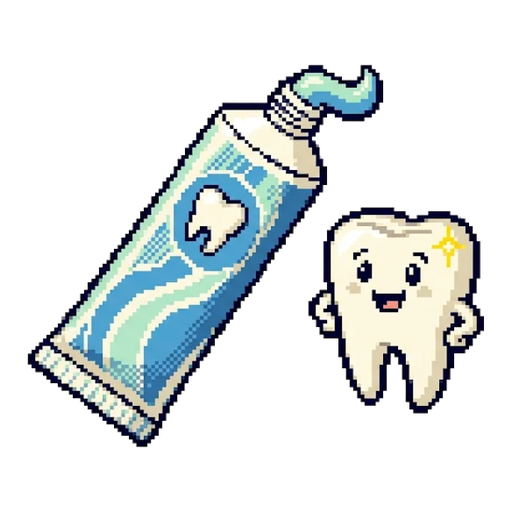
This is an illustration of a tube of toothpaste and shiny, sparkling teeth. It shows in a simple picture that fluorides help protect teeth. The shapes of the tube and teeth and the sparkle are illustration style, different from the real things. Real fluorine gas is pale yellow, and what is in toothpaste is not fluorine gas but a compound called a fluoride.
Fun facts
- It took more than 70 years of effort by many chemists before pure fluorine was finally separated.
- The word "fluorescence" comes from fluorite, a stone that glows under ultraviolet light.
- Fluorine is said to have the greatest power of all elements to pull in electrons.
Quick quiz
Q. What are fluorine compounds (fluorides) in toothpaste said to do?
Fluorides are said to help prevent cavities by making the surface of teeth stronger against acid.
References
- 『理科年表』 (edited by the National Astronomical Observatory of Japan, published by Maruzen): properties of elements and atomic weights
- IUPAC (International Union of Pure and Applied Chemistry) atomic weights table (Commission on Isotopic Abundances and Atomic Weights): standard atomic weight of fluorine
- Dental and oral health materials from local governments such as Nara Prefecture, Shinjuku City, Saitama Prefecture and Fukushima Prefecture: how to use fluoride toothpaste and how common it is
- Royal Society of Chemistry periodic table page, Fluorine: properties and history of discovery
- Encyclopaedia Britannica, "Fluorine": properties, Moissan's isolation of the element, origin of the name
Accounts may differ between sources and regions, and facts or figures can change with new research or rules. This page was translated from the Japanese original.
Download the pixel art
- Free
- No registration
- Commercial use OK
- Edits OK
- Credit optional
- No usage report needed
Please read the terms of use before using it.