



Periodic Table Encyclopedia No.007
Nitrogen
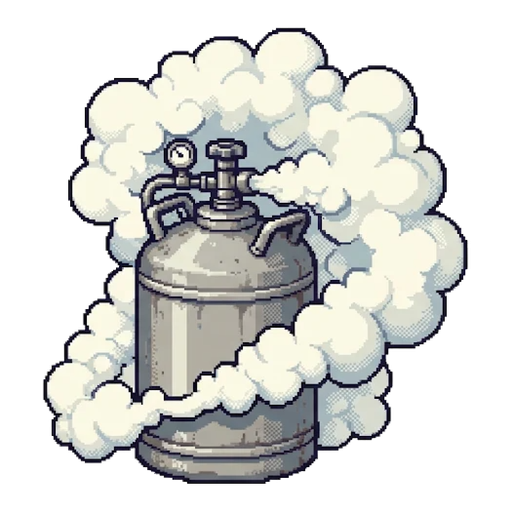
NonmetalGaseous elementGroup 15, Period 2
Atomic number 7, symbol N. A colorless, odorless gas that makes up about 80% of air. It is useful for fertilizer, keeping food fresh, and cooling things.
Key facts
| Atomic number / Symbol | 7 / N |
|---|---|
| Type | Nonmetal |
| Place in the periodic table | Group 15, Period 2 |
| State at room temperature | Gas (colorless and odorless. It exists as N₂ molecules, in which two atoms are joined together) |
| Atomic weight | About 14.007 (a simplified value of the IUPAC standard atomic weight, as of the 2020s) |
| Boiling point (the temperature at which it becomes a liquid) | About minus 196°C (about 77 kelvin) |
| Share of air | About 78% by volume (in dry air) |
| Discovery | Said to have been reported in 1772 by Rutherford of Scotland in his doctoral thesis. Scheele, Cavendish and Priestley were also studying it around the same time, and accounts differ |
| Origin of the name | The English name nitrogen comes from the Greek word nitron, meaning "niter" (a salt used to make gunpowder and fertilizer), and a word meaning "producer." It means "the thing that makes niter." It is said to have been proposed around 1790 by Chaptal of France. Lavoisier and others used the name azote, meaning "not supporting life," which is still used today in French and other languages (the details differ by account) |
What kind of element is it?
Nitrogen is the element with the symbol N and atomic number 7. At ordinary temperatures it is a gas with no color and no smell.
Nitrogen atoms usually float in the air as molecules (tiny particles made of atoms joined together), with two atoms holding hands tightly. This grip is so strong that nitrogen does not react easily with other substances.
The Japanese name for nitrogen is said to mean "the element that blocks breathing (causes suffocation)," because it supports neither burning nor breathing. It is said to have been translated from Dutch in the 1830s by Udagawa Yōan, a scholar of Dutch learning from the Edo period (a person who studied Western science through the Dutch language). However, nitrogen itself is not poisonous.
The history of its discovery
In 1772, Rutherford, a Scottish doctor and chemist, reported on nitrogen in his doctoral thesis.
Rutherford let a small animal (a mouse) breathe in a sealed container. He then burned a candle and phosphorus in it to remove the oxygen and carbon dioxide. The air that was left put out fire and could not keep living things alive. He called it by a word meaning "poisonous air."
Around the same time, Scheele, Cavendish, Priestley and others were studying similar gases. Rutherford published his work as a paper, so he is often called the discoverer. But accounts differ about who was first.
Later, Lavoisier of France and others sorted air into a "gas that helps things burn" and a gas that does not. In that work, this gas was given names such as azote and nitrogène.
Everyday uses
Nitrogen is one of the nutrients that plants need to grow. It is a major part of the fertilizer spread on fields. At the start of the 20th century, a way to make ammonia (a raw material for fertilizer) from nitrogen in the air became practical. This helped people grow much more food.
Nitrogen is also often used as the gas inside snack bags. It has little oxygen, so the food inside spoils less easily.
Liquid nitrogen is used as a tool to cool things quickly, in research, medicine and food freezing.
Secrets of its properties
Nitrogen changes from a gas to a liquid at about minus 196°C. This liquid nitrogen is a very cold liquid.
The white smoke-like cloud you see coming from a container is not nitrogen itself. The cold nitrogen cools the water vapor (water as a gas) in the air nearby, and it turns into tiny drops of water that look white. Nitrogen gas cannot be seen.
Touching liquid nitrogen directly can cause frostbite (an injury from extreme cold). In a small room, nitrogen that turns into gas can also lower the amount of oxygen. Leave handling to people who know how, and check safety rules with information from public agencies.
Nitrogen on Earth and in space
About 78% of Earth's air by volume is nitrogen, the largest share among the gases in air.
Nitrogen is also essential to living bodies. Proteins (the materials that build the body) and DNA (the source of heredity) contain nitrogen.
Most living things cannot use the nitrogen in the air as it is. Bacteria living on the roots of legume plants, and others, change it into a form plants can use. It then passes to animals through food, and in time returns to the air. This is called the nitrogen cycle (going around and around).
About this illustration
An illustration of a liquid nitrogen container with white smoke pouring out. The smoke is water vapor in the air, cooled by the cold nitrogen, and it looks white. It is not nitrogen gas itself. The shape and color of the container and the amount and spread of the smoke are only artistic choices, and differ from the real thing.
Fun facts
- Nitrogen makes up about 78% of air by volume. It is the most plentiful gas in air.
- The white smoke from liquid nitrogen is water vapor in the air that has turned into tiny drops after being cooled. Nitrogen gas cannot be seen.
- Proteins and DNA, which build living bodies, contain nitrogen. Bacteria on the roots of legume plants change nitrogen in the air into a form plants can use.
Quick quiz
Q. What is the white smoke that comes from a container of liquid nitrogen?
Nitrogen gas cannot be seen. The very cold nitrogen cools the air around it, and the water vapor turns into tiny drops of water that look white.
References
- IUPAC Commission on Isotopic Abundances and Atomic Weights (CIAAW), "Standard Atomic Weights": supports the standard atomic weight of nitrogen
- Atomic weight table by the Commission on Atomic Weights of the Chemical Society of Japan: supports the atomic weight value
- Rika Nenpyo (Chronological Scientific Tables), edited by the National Astronomical Observatory of Japan (Maruzen Publishing): supports numbers such as the boiling point and the makeup of air
- National Institute for Materials Science (NIMS) element data, "Nitrogen": supports the melting and boiling points
- Royal Society of Chemistry, "Periodic Table: Nitrogen": supports the discovery and properties of nitrogen
- Encyclopaedia Britannica, "Nitrogen": supports the history of discovery and the origin of the name
- Reference works such as the Nihon Daihyakka Zensho (Kotobank entries "窒素" and "宇田川榕菴"): support the origin of the Japanese name
Accounts may differ between sources and regions, and facts or figures can change with new research or rules. This page was translated from the Japanese original.
Download the pixel art
- Free
- No registration
- Commercial use OK
- Edits OK
- Credit optional
- No usage report needed
Please read the terms of use before using it.