



Periodic Table Encyclopedia No.005
Boron
MetalloidGroup 13, Period 2A solid element
Boron has atomic number 5 and the symbol B. Its name comes from borax, the mineral it was first taken from. It is used in surprising places, such as heat-resistant glass, fertilizer and parts of nuclear reactors.
Key facts
| Atomic number | 5 |
|---|---|
| Symbol | B |
| Type | Metalloid (an element with properties between those of a metal and a nonmetal) |
| Place in the periodic table | Group 13, Period 2 |
| State at room temperature | Solid (the pure crystal form is blackish and very hard) |
| Atomic weight | About 10.81 (the IUPAC standard atomic weight. The value changes slightly with the mix of isotopes, so it is also given as a range of 10.806 to 10.821) |
| Melting point | About 2076°C (it differs a little depending on the source) |
| Discovery | 1808. Gay-Lussac and Thénard in France, and Davy in Britain, are said to have each isolated it (accounts differ) |
| Origin of the name | From the mineral borax. The word borax is said to go back to Arabic and Persian words for borax |
What kind of element is it?
Boron is the 5th element in the periodic table. It belongs to the "metalloids," elements that can act like a metal and like a nonmetal.
Pure boron crystal (the element on its own) is a blackish, very hard solid. It is said to need a high temperature of about 2076°C to melt (it differs a little depending on the source).
In nature, most boron is found in compounds called "borates." These are in minerals and in water.
The history of its discovery
People have used borax since very long ago. It has been used in glazes (the glassy coating on pottery) and as a flux, which helps when joining metals.
But the element itself was first taken out in 1808. Gay-Lussac and Thénard in France, and Davy in Britain, are said to have done it at about the same time, using boric acid. Sources differ on who should be called the discoverer.
What they got was still mixed with many impurities. Highly pure boron is said to have first been made around 1909 (by Weintraub in the United States). But because of earlier research, accounts differ.
The secret of its name
The name boron comes from borax. The word borax is said to come from Arabic and Persian words for borax.
Some explain that the English name boron combines borax with carbon, an element with similar properties. The Japanese word for boron uses the character for borax.
Everyday uses
Boron compounds are useful in daily life.
First, heat-resistant glass. Glass mixed with boron (borosilicate glass) can handle sudden changes in temperature. It is used for beakers in science experiments.
Next, boric acid and borax. Boric acid, diluted, has been used as an eyewash and in pest-control products such as boric acid balls for insects. Borax is a material for glass and glazes.
Boron is also one of the nutrients plants need to grow, and it is found in fertilizer. But too much can actually harm plants.
The secrets of its properties
Boron includes a kind (boron-10) that absorbs neutrons very well. Neutrons are tiny particles in the center of an atom. Because of this, boron is used in control rods, which adjust the power of a nuclear reactor.
Boron compounds differ in how toxic they are. Boric acid, for example, is dangerous to swallow or to use in large amounts. For details, please check information from public agencies.
About this illustration
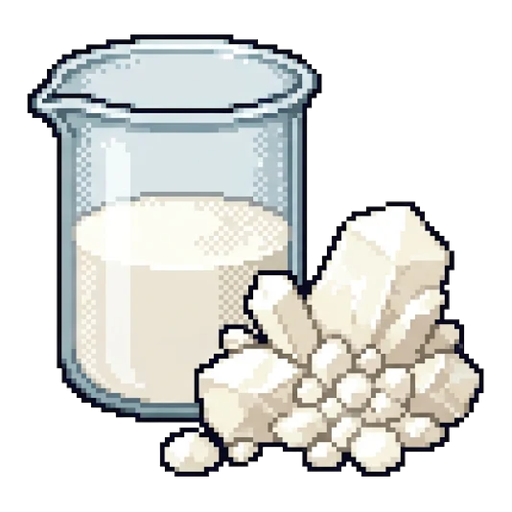
This picture shows a heat-resistant glass beaker next to white crystals of borax. The clear beaker stands for a typical use of boron in heat-resistant glass. The white crystals are borax, the source of the name. The shape of the beaker, the way the crystals are arranged and the colors of the background are drawn to make the picture easy to see. They are illustration style and differ from the real thing.
Fun facts
- Highly pure boron is said to have been made around 1909, about 100 years after its discovery (accounts differ).
- Boron is one of the nutrients plants need, but too much can harm them.
- Boron-10 absorbs neutrons well, so it is used in the control rods of nuclear reactors and similar parts.
Quick quiz
Q. Which mineral gave boron its name?
The name boron comes from borax. In 1808, the element was taken out of substances such as boric acid, which is made from borax.
References
- CIAAW (Commission on Isotopic Abundances and Atomic Weights) / IUPAC standard atomic weights table (supports the range for boron's atomic weight)
- 国立天文台編『理科年表』 (Chronological Scientific Tables, supports element properties and periodic table data)
- Los Alamos National Laboratory『Periodic Table of Elements』Boron (supports basic data and history)
- WebElements『Boron: history』 (supports the 1808 isolation and the discoverers)
Accounts may differ between sources and regions, and facts or figures can change with new research or rules. This page was translated from the Japanese original.
Download the pixel art
- Free
- No registration
- Commercial use OK
- Edits OK
- Credit optional
- No usage report needed
Please read the terms of use before using it.